
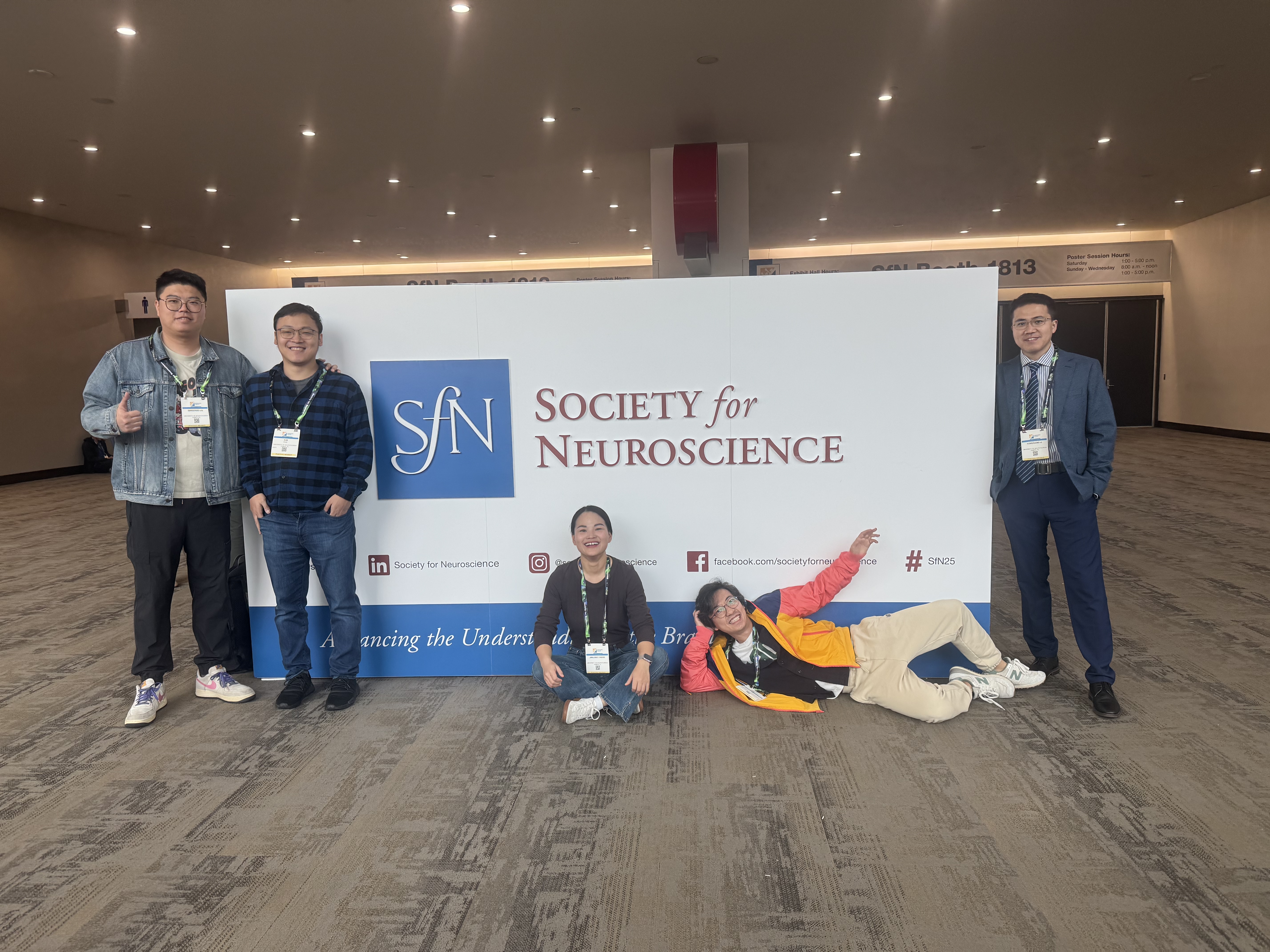
Dr. Yongxiang Li, Dr. Qingzhuo Liu, Dr. Yue (Alvin) Deng, Dr. Jingjing (Jane) Cheng, and Dr. Xi Wu from Dr. Yong Xu’s lab presented their research at the 2025 Society for Neuroscience in San Diego. During the meeting, all participants received constructive feedback on their work, explored cutting-edge discoveries from neuroscientists around the world, and gained valuable insights to guide their future studies. In addition, these early-career scientists participated in multiple career-development workshops focused on scientific writing, career pathways, and the job-application process. In addition, they also served as volunteers at the SfN 2025 Chinese Neuroscientists Social. Overall, it was a highly productive and inspiring week for everyone involved.

Dr. Yongxiang Li was awarded SfN 2025 Trainee Professional Development Award and presented at a press conference on the theme of “Parenting”. Fewer than 50 abstracts out of 10,000 were selected for press at SfN. During the one-hour session, three speakers were invited to give five-minute talks, followed by a press Q&A. Dr. Li presented on “How Fatherhood Changes the Male Brain,” highlighting how fatherhood can shape the male brain and promote more fatherhood care behaviors toward offspring. As he is currently experiencing his own transition into fatherhood, Dr. Li also shared his personal journey as a new dad. This opportunity further strengthened his commitment to studying parenting behaviors.

Dr. Qingzhuo Liu’s abstract was selected for a 15-minute nanosymposium presentation at the meeting. In his talk, Dr. Liu presented new findings on how the microglial THIK-1 channel modulates feeding behavior by regulating hypothalamic AgRP neurons. His presentation drew strong interest from attendees, prompting thoughtful questions and positive feedback from researchers across multiple institutions. This opportunity stimulated new ideas and potential collaborations that will contribute to the next steps of his research program.

Dr. Deng presented a poster titled “VMH AR Neurons Regulate Metabolic Homeostasis” which highlighted the sexual dimorphism of VMH AR neurons in metabolic regulation. During the poster session, Dr. Deng engaged with scientists from diverse fields—including metabolism, animal behavior, nuclear receptor biology, and data science. These interdisciplinary discussions provided valuable perspectives that will help shape Dr. Deng’s future research.

Dr. Cheng presented her poster titled "From Gene to Function: Modeling a Human Gpr101 Obesity Variant in Mice", identifying the Gpr101 gene as a causative gene of diet-induced obesity. Throughout the presentation, she actively engaged with attendees, introducing her work on GPR101's role in energy homeostasis and incorporating insightful feedback to refine future studies on its physiological function.

Dr. Wu presented a poster titled “The Metabolic Function of ERα Neurons in the Spinal Cord,” which focused on how ERα-expressing spinal neurons regulate locomotor activity and energy metabolism. During the poster session, his work attracted significant attention from experts in the field, who offered valuable feedback and suggestions that will greatly inform future directions of this research.

Dr. Liu and Dr. Deng served as volunteers at the Chinese Neuroscientists Social Meeting.
