

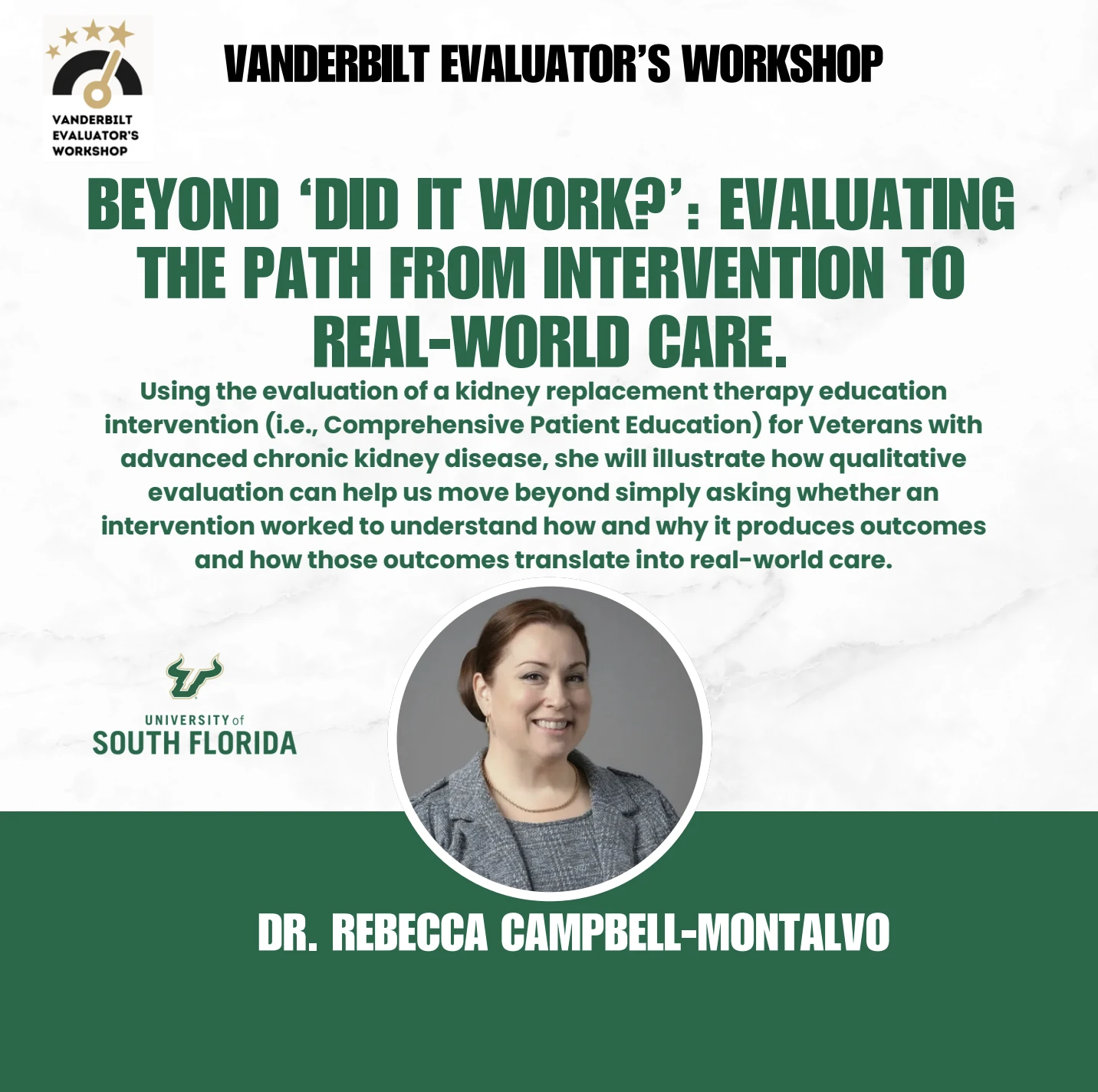
On September 21, 2026, Dr. Campbell-Montalvo delivered an invited presentation followed by Q&A at the Vanderbilt University Evaluator’s Workshop. Titled “Beyond ‘Did It Work?’: Evaluating the Path from Intervention to Real-World Care,” the session focused on how qualitative evaluation can move beyond assessing whether an intervention is effective to understanding how and why outcomes occur and how they translate into real-world care.
Drawing on the evaluation of a Comprehensive Patient Education (CoPE) intervention for Veterans with advanced chronic kidney disease, Dr. Campbell-Montalvo illustrated how patient experiences, social relationships, clinical processes, and organizational contexts can shape the pathway from education and treatment decision-making to care received. The research is part of TEACH-VET, an intervention trial of more than 500 Veterans led by Dr. Ashutosh Shukla at the University of Florida, which contains an embedded qualitative evaluation. The presentation drew on multiple complementary datasets, including interviews conducted by Dr. Campbell-Montalvo with Veterans before dialysis initiation (n=42), follow-up interviews after treatment initiation (n=15), and focus groups with providers and hospital leaders (n=36). Together, these data allowed the evaluation to follow the pathway from education and treatment choice through implementation, while identifying how social support, patient preferences, clinical transitions, and organizational barriers can shape whether an informed treatment decision ultimately becomes real-world care. Check out Dr. Campbell-Montalvo’s recent article on this research.
The presentation highlighted how qualitative evaluation can reveal mechanisms that traditional quantitative and clinical measures alone may not capture, including how patients make sense of new information, assess the feasibility of treatment options within their social worlds, and navigate barriers between informed treatment choices and implementation. It also highlighted the importance of conducting evaluation beyond treatment selection, to include treatment use.
Based on this work, Dr. Campbell-Montalvo offered participants three key lessons for evaluators: examine mechanisms (why and how) rather than experiences (what) alone, follow outcomes beyond the intervention encounter, and expand evaluation to consider social networks, providers, organizations, resources, timing, and transitions as parts of the pathway linking interventions to real-world outcomes.
AQUASS appreciates Vanderbilt Evaluator’s Workshop for the invitation, with special thanks to Xingchen Wei for helping coordinate the event.
